
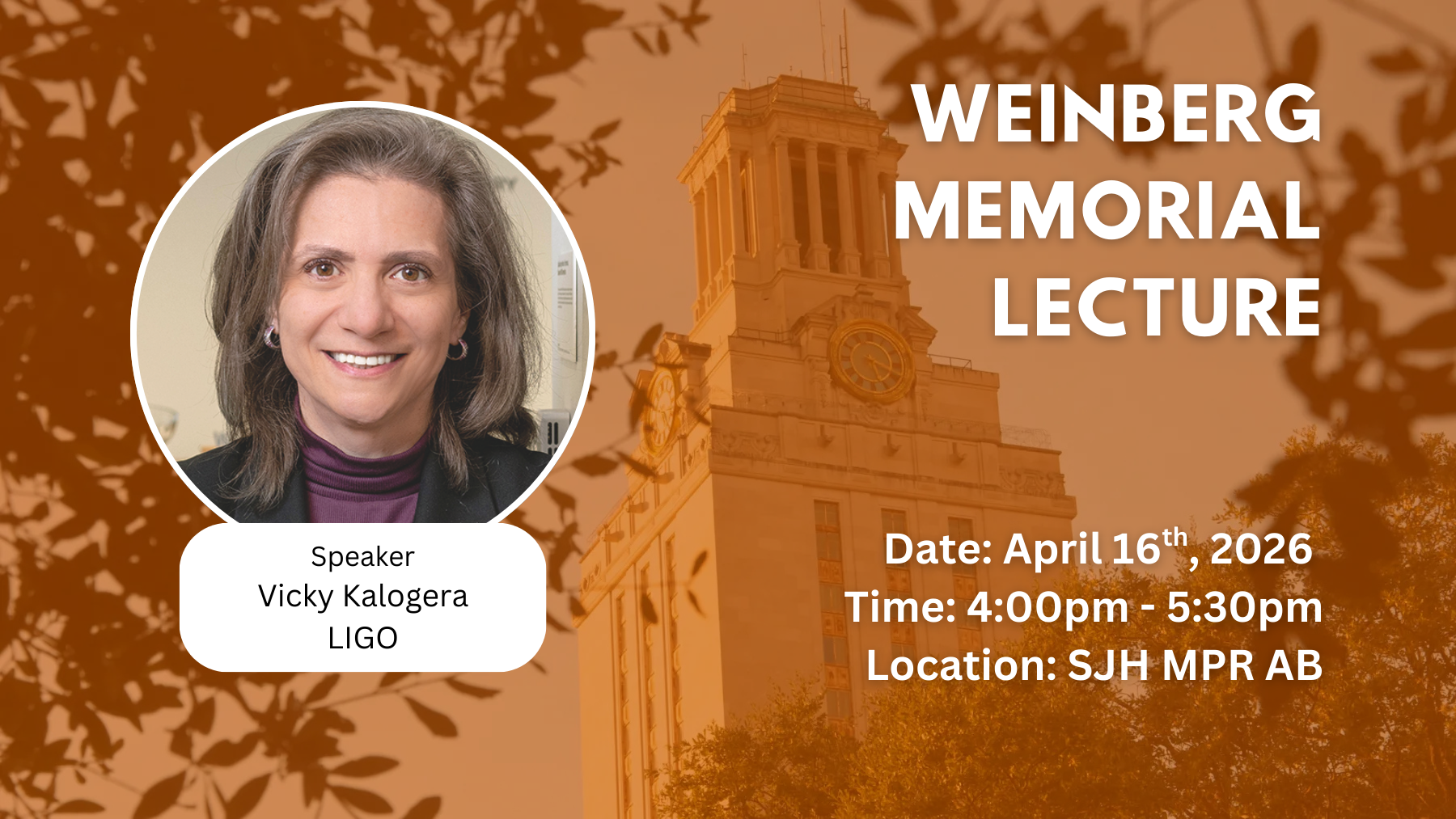
Weinberg Memorial Lecture with Vicky Kalogera
Apr
16
2026
Apr
16
2026
(Registration strongly encouraged; please see the link to register above, next to the subtitle)
The Physics Department and Weinberg Institute of Theoretical Physics at UT Austin invite you to the 2026 Weinberg Memorial Lecture. Held every two years, this event honors Steven Weinberg, renowned physicist and former UT Physics faculty member.
Dr. Vicky Kalogera, the Daniel I. Linzer Distinguished University Professor in the Department of Physics and Astronomy at Northwestern University, will give this year’s lecture on Thursday, April 16 at 4:00 PM in the San Jacinto Hall Multipurpose Conference Room AB.
Kalogera will present "Listening to Cosmic Collisions: Black Holes, Neutron Stars, and the Rise of Gravitational-Wave Astrophysics,” in which she will guide us through the myriad revelations about the nature of the universe discovered through gravitational wave physics, and the exciting potential of increasingly sophisticated instruments in the field.
Abstract: A century before their discovery, Albert Einstein predicted the existence of gravitational waves as a consequence of his theory of relativity. These waves are tiny ripples produced when massive objects accelerate, most dramatically during collisions between black holes and neutron stars. Over the past decade, observatories such as LIGO and Virgo have made it possible to detect these signals on Earth, allowing us to listen to cosmic collisions that were previously invisible. By measuring gravitational waves, astronomers now probe how massive stars form, interact, and ultimately live and die, leaving behind compact remnants that spiral together and merge. Observations of black hole and neutron star mergers reveal their masses, spins, and environments, offering insight into extreme physical conditions inaccessible by any other means. Looking ahead, expanding detector networks and steadily improving sensitivity promise to grow gravitational-wave astronomy from a young discovery-driven field into a mature and far-reaching branch of observational science, with the potential to detect relic gravitational waves from the early universe, an area shaped in part by Steven Weinberg’s work.
Bio: Vicky Kalogera is a leading astrophysicist recognized for her pioneering work on compact objects—black holes, neutron stars, and white dwarfs—and for her leadership in gravitational-wave astrophysics. She earned her B.S. in Physics from the University of Thessaloniki, Greece, and her Ph.D. in Astronomy from the University of Illinois at Urbana-Champaign, followed by a postdoctoral fellowship at the Harvard-Smithsonian Center for Astrophysics. Kalogera is the Daniel I. Linzer Distinguished University Professor in the Department of Physics and Astronomy at Northwestern University. She co-founded and directs the Center for Interdisciplinary Exploration and Research in Astrophysics (CIERA), fostering collaborations across astrophysics, data science, and computation. Her recent leadership includes chairing Northwestern’s Data Science/AI Steering Committee and directing the NSF-Simons AI Institute for the Sky (SkAI), which develops advanced AI tools for astronomy. Kalogera is a key member of the LIGO Scientific Collaboration, contributing to the first direct detection of gravitational waves in 2015. Her research bridges stellar evolution, gravitational-wave sources, and data-driven astrophysics, integrating machine learning and high-performance computing. Her scientific achievements have been recognized with the Hans A. Bethe Prize (APS, 2016), Dannie Heineman Prize for Astrophysics (AIP & AAS, 2018), Guggenheim Fellowship (2021), and several collaborative honors including the Special Breakthrough Prize in Fundamental Physics (2016) and the Bruno Rossi Prize (2017). She is an elected member of the National Academy of Sciences (2018) and the American Academy of Arts and Sciences (2021), and a Fellow of the APS, AAAS, and AAS.
Location
San Jacinto Residence Hall MPR AB
309 E 21st St.
Austin, TX 78705
Share
Audience
Other Events in This Series
Mar
21
2022
Weinberg Memorial Lecture with Frank Wilczek
Join the College of Natural Sciences for the inaugural Steven Weinberg Memorial Lecture in honor and memory of CNS professor and Nobel Laureate Steven Weinberg.
4:00 pm – 5:15 pm • In Person
Speaker(s): Frank Wilczek

Apr
10
2024
Weinberg Memorial Lecture with James Peebles
Nobel laureate Dr. James Peebles will discuss the still-unanswered questions regarding the expansion of the universe, dark matter and more.
4:00 pm – 5:15 pm • In Person
Speaker(s): Jim Peebles
